
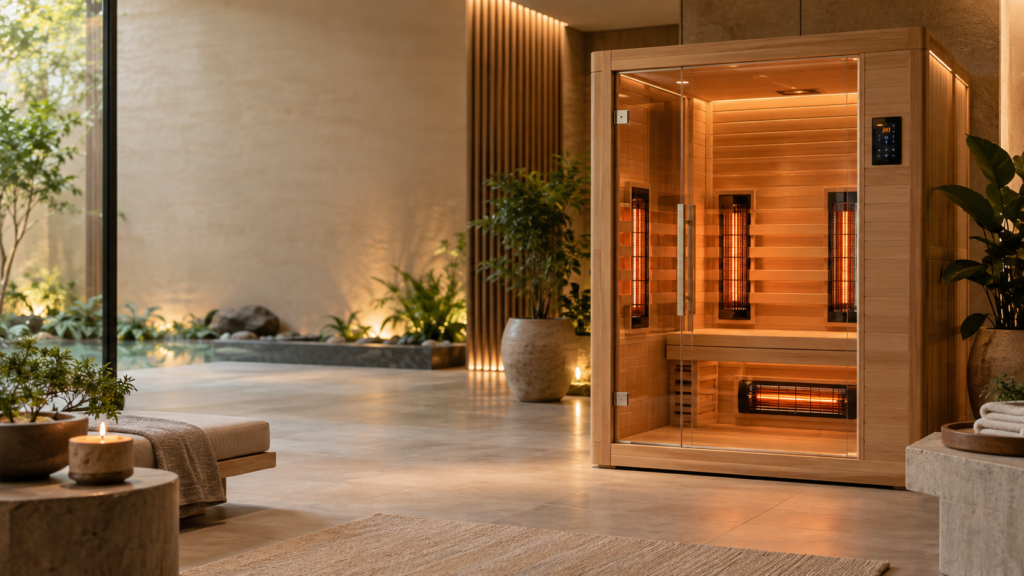
If you are researching modern sauna technology, one of the most common questions is: how does infrared sauna work?
Unlike a conventional sauna that primarily heats the surrounding air, an infrared sauna uses infrared energy to warm the body more directly. The absorbed energy is converted into heat, creating the warm environment, sweating and relaxation commonly associated with sauna use.
Far infrared sauna systems are increasingly used in wellness centres, Ayurveda centres, naturopathy facilities, spas and premium wellness spaces because they can operate at lower air temperatures than many traditional sauna environments.
What Is an Infrared Sauna?
An infrared sauna is an enclosed sauna cabin equipped with infrared-emitting heating elements.
Infrared is part of the electromagnetic spectrum and sits beyond visible red light. Although infrared wavelengths cannot be seen by the human eye, their energy can be experienced as heat.
When infrared energy reaches the body, part of that energy is absorbed and converted into thermal energy. This increases skin temperature and produces the warming sensation associated with an infrared sauna session.
How Does Infrared Sauna Work?
The basic operation of an infrared sauna can be explained in four steps.
1. Infrared Heating Elements Produce Radiant Energy
Infrared sauna cabins contain heating panels or infrared emitters positioned around the cabin.
When the system is switched on, these emitters produce infrared radiation that travels through the cabin as radiant energy.
2. The Body Absorbs the Infrared Energy
Instead of relying only on extremely hot surrounding air, infrared energy reaches the body’s surface directly.
The absorbed energy is converted into heat, raising skin temperature and gradually warming the body.
3. Body Temperature and Circulation Respond to Heat
As the body becomes warmer, normal physiological heat responses can occur. These may include increased sweating, widening of superficial blood vessels and an increase in heart rate.
These responses are part of the body’s natural attempt to regulate temperature during heat exposure.
4. Sweating Helps the Body Regulate Temperature
Sweating is one of the body’s primary cooling mechanisms. As perspiration evaporates from the skin, it helps dissipate heat.
Sweating should not automatically be interpreted as proof that a sauna removes specific toxins from the body. Claims about medical detoxification should be distinguished from the normal process of sweating.
What Is Far Infrared Sauna Technology?
Far infrared, commonly abbreviated as FIR, refers to a portion of the infrared spectrum used in many modern sauna systems.
Far-infrared sauna heaters produce radiant heat that is absorbed at and near the skin and converted into warmth.
For the user, the important practical difference is that infrared technology can create a significant warming experience without requiring the surrounding air to reach the same high temperatures commonly associated with conventional saunas.
Infrared Sauna vs Traditional Sauna: What Is the Difference?
| Feature | Infrared Sauna | Traditional Sauna |
|---|---|---|
| Primary heating method | Infrared radiant energy warms the body more directly | Heats the surrounding air, which then heats the body |
| Typical environment | Generally lower air temperature | Generally higher air temperature |
| Heating source | Infrared panels or emitters | Electric heater, heated stones or other conventional heat source |
| Experience | Radiant, direct-feeling warmth | Very hot surrounding air |
| Common professional use | Wellness centres, spas and infrared sauna facilities | Gyms, spas, hotels and traditional sauna facilities |
Why Can Infrared Saunas Operate at Lower Air Temperatures?
A conventional sauna needs to heat the surrounding air significantly before the air transfers enough heat to the body.
Infrared systems transfer part of their energy through radiation rather than depending only on hot air.
This is why users can experience substantial warmth and sweating even when the surrounding cabin temperature is lower than that of many traditional saunas.
What Happens to Your Body During an Infrared Sauna Session?
Heat exposure can trigger several normal physiological responses.
During an infrared sauna session, a person may experience:
- increased skin temperature
- increased sweating
- temporary increase in heart rate
- widening of superficial blood vessels
- feeling of warmth and relaxation
- temporary fluid loss through sweating
Because sweating causes fluid loss, hydration is an important part of responsible sauna use.
Does Infrared Heat Penetrate the Body?
Infrared sauna marketing often uses phrases such as “deep heat.” It is useful to understand what this means carefully.
Far-infrared energy interacts with the body’s surface and nearby tissues and is converted into heat. The resulting warming response can then affect the body more broadly through normal heat transfer and circulation.
The exact biological effects depend on wavelength, intensity, duration, distance from the infrared source and other factors.
What Temperature Does an Infrared Sauna Use?
Infrared sauna cabins generally operate at lower air temperatures than many traditional saunas.
Exact temperature settings depend on the sauna design, manufacturer, user preference and professional operating protocol.
Users should always follow the equipment manufacturer’s recommended temperature, session duration and operating instructions.
How Long Does an Infrared Sauna Session Take?
There is no universal session length suitable for everyone.
The appropriate duration depends on factors including:
- individual heat tolerance
- temperature setting
- health status
- hydration
- previous sauna experience
- manufacturer guidelines
People who are new to sauna use are generally better suited to shorter, more conservative sessions rather than immediately attempting prolonged heat exposure.
What Are Infrared Saunas Commonly Used For?
Infrared saunas are widely used in wellness settings primarily for heat exposure, relaxation and the sauna experience.
Research has also explored sauna use in areas such as cardiovascular responses, muscle and joint comfort and other health-related outcomes. However, evidence varies depending on the condition being studied and larger, well-controlled studies are still needed for many proposed medical benefits.
Infrared sauna should therefore not be presented as a replacement for appropriate medical diagnosis or treatment.
Is Infrared Sauna the Same as Red Light Therapy?
No.
Although both technologies use portions of the electromagnetic spectrum, infrared sauna and red light therapy are not the same treatment technology.
Infrared sauna is primarily designed to generate heat. Red light therapy typically uses specific red or near-infrared wavelengths at different energy levels for photobiomodulation applications.
Some advanced wellness systems may include both technologies within the same cabin, but they remain distinct functions.
What Should You Look for in a Professional Infrared Sauna?
If you are evaluating equipment for a wellness centre, spa, Ayurveda facility or naturopathy centre, look beyond appearance alone.
Important equipment considerations include:
- infrared heating technology
- temperature control
- temperature monitoring
- air circulation
- operator interface
- automatic controls
- cabin construction
- available seating capacity
- installation requirements
- warranty and technical support
How the Tathya Far Infrared Sauna Works
The Tathya Far Infrared Sauna is designed for professional wellness environments and uses a solid-state far-infrared heating system.
The system includes features intended to help trained operators control and monitor the sauna environment, including:
- far-infrared heating technology
- touchscreen operation
- multi-zone temperature monitoring
- temperature regulation panels
- air circulation vent
- fully automatic operation
- reading light
- single, double and four-seater configurations
These features are designed to make the sauna suitable for professional wellness centres, spas, Ayurveda centres and naturopathy facilities.
Who Should Be Careful With Infrared Sauna Use?
Heat exposure is not appropriate for everyone.
People should seek medical guidance before sauna use when relevant, particularly if they have cardiovascular conditions, significant blood-pressure problems, are pregnant, take medications that affect heat regulation or blood pressure, or have another medical condition that may affect heat tolerance.
Sauna use should also be avoided when a person is dehydrated or under the influence of alcohol.
Anyone who experiences dizziness, nausea, unusual weakness or other concerning symptoms should leave the sauna and cool down.
How to Use an Infrared Sauna More Responsibly
- Follow the equipment manufacturer’s instructions.
- Begin conservatively if you are new to sauna use.
- Stay adequately hydrated.
- Avoid alcohol before and during sauna use.
- Do not stay inside simply to tolerate discomfort.
- Leave the sauna if you feel dizzy, nauseated or unwell.
- Seek medical advice when health conditions make heat exposure uncertain.
Infrared Sauna Technology for Wellness Centres
For a professional wellness business, the equipment selection process should consider more than the infrared heating system itself.
Centre owners should also evaluate:
- available cabin size
- number of users per session
- room space
- electrical requirements
- installation
- operator training
- maintenance
- after-sales technical support
The correct sauna configuration depends on the centre’s expected utilisation, available space and business model.
Looking for a Far Infrared Sauna for Your Wellness Facility?
If you are planning a wellness centre, Ayurveda centre, naturopathy facility, spa or similar professional setup, request product specifications, installation requirements and commercial information for the Tathya Far Infrared Sauna.
Call / WhatsApp: +91 77368 75897
Request Product Details