
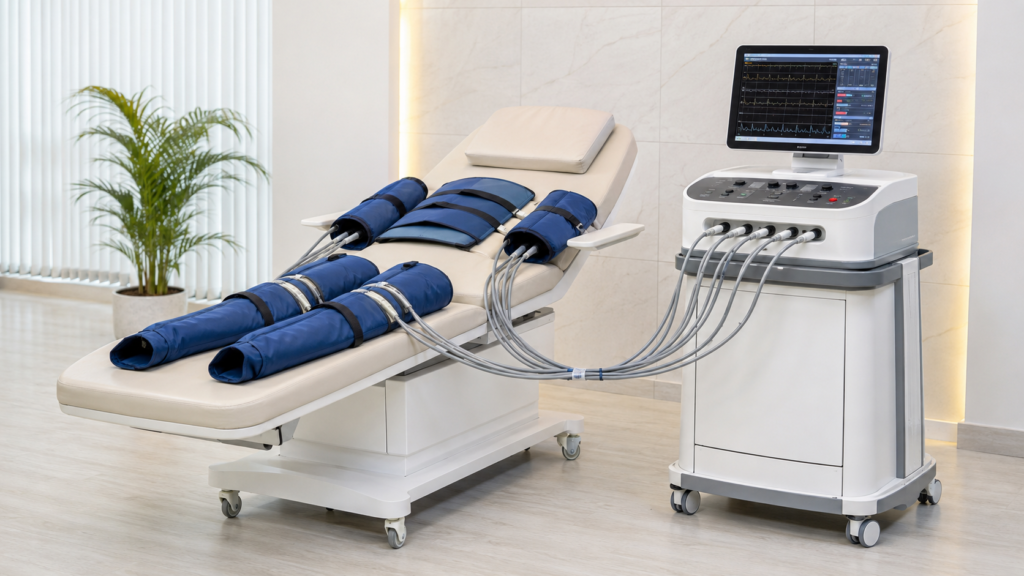
An EECP machine is an important part of a cardiac-care facility’s treatment infrastructure. When the machine develops pressure inconsistencies, ECG synchronisation problems, pneumatic leakage, system alarms or accessory damage, treatment schedules may be interrupted and the equipment may remain unused.
Liyan Meditech System provides professional EECP machine service in India for hospitals, cardiac centres, EECP clinics, rehabilitation facilities and healthcare organisations. Our technical support focuses on systematic fault assessment, equipment inspection, preventive maintenance and responsible engineering support.
Service requirements are evaluated according to the machine brand, model, age, current condition, operating history and availability of compatible components. Clinics should not continue using a machine that is showing abnormal behaviour, irregular pressure delivery, damaged accessories or unresolved error messages.
For faster preliminary assessment, clients can share the machine details, photographs, videos and a description of the reported problem before requesting an onsite visit.
Need EECP machine support?
Contact Liyan Meditech System with your machine model, location and fault details to request an initial service assessment.
What Is an EECP Machine?
EECP stands for Enhanced External Counterpulsation. An EECP system is an external counterpulsating cardiovascular device that uses inflatable pneumatic cuffs placed around the patient’s lower body. The cuffs operate in coordination with the patient’s cardiac cycle using monitored physiological signals.
Regulatory descriptions classify these systems as external counter-pulsating devices within the cardiovascular medical-device category. Depending on the design, a system may include a treatment console, patient bed, ECG monitoring or triggering components, pneumatic cuffs, hoses, pressure-control components and related accessories.
Because pressure generation, signal monitoring and timing coordination must work together, a problem in one subsystem can affect the overall performance of the machine.
EECP equipment should therefore be inspected and serviced by personnel familiar with medical equipment, pneumatic systems, electrical safety and the specific machine model.
Professional EECP Machine Service in India
Liyan Meditech System supports healthcare facilities looking for reliable EECP machine service in India.
Service support may be requested by:
- Multi-speciality hospitals
- Cardiac hospitals
- Heart-care clinics
- EECP treatment centres
- Cardiac rehabilitation centres
- Medical colleges
- Biomedical engineering departments
- Medical-equipment dealers
- Healthcare groups operating multiple centres
Support is planned according to the reported issue and machine condition. Some enquiries may begin with remote technical assessment, while other faults may require an onsite inspection.
The objective is to identify the likely source of the problem, assess the condition of the equipment and recommend an appropriate service plan without making assumptions based only on a phone description.
Why Timely EECP Machine Maintenance Matters
An EECP machine is generally expected to perform repeated treatment sessions involving coordinated monitoring and pneumatic pressure cycles. Unexpected downtime can affect patient scheduling, staff productivity and utilisation of the treatment room.
The manufacturer of established EECP systems describes EECP as both a medical device and a structured clinical service line requiring consistent operational support. Equipment reliability and ongoing support are therefore important for maintaining a functioning EECP programme.
Timely maintenance can help a clinic:
- Identify wear before it results in a major breakdown.
- Reduce avoidable machine downtime.
- Detect damaged cuffs, connectors or hoses.
- Check whether pressure delivery is consistent.
- Address recurring alarms or signal problems.
- Plan replacement of worn accessories.
- Maintain service and maintenance documentation.
- Improve confidence before scheduling patients.
- Decide whether repair, replacement or further testing is required.
Preventive maintenance does not guarantee that a machine will never fail. However, it can help detect visible deterioration and performance concerns before they become more disruptive.
Common EECP Machine Problems Reported by Clinics
The exact cause of a fault cannot be confirmed without proper assessment. However, hospitals and clinics commonly request service support for the following types of problems.
1. Machine Not Powering On
The system may not start, may shut down unexpectedly or may display an incomplete start-up sequence.
Possible causes can involve the power supply, internal electronics, safety circuits, connectors or other system components. The machine should be disconnected from clinical use until it has been appropriately assessed.
2. Low or Inconsistent Cuff Pressure
A clinic may observe that one or more cuffs are not inflating correctly, pressure is slow to build or pressure differs between treatment zones.
This can be associated with:
- Worn cuffs
- Loose connections
- Damaged hoses
- Air leakage
- Valve-related problems
- Pneumatic control issues
- Compressor-performance concerns
- Incorrectly connected accessories
The complete pneumatic path may need to be inspected rather than replacing a cuff based only on assumption.
3. Air Leakage From Cuffs or Hoses
Small leaks can reduce the machine’s ability to maintain the required pressure. A leak may occur at a cuff, hose, connector, joint or another pneumatic component.
Visible cracks, loose fittings, repeated pressure loss or unusual air sounds should be reported during the service enquiry.
4. ECG Signal Not Detecting Properly
The machine may show a weak, unstable or noisy ECG signal. This can prevent reliable triggering or cause the treatment cycle to behave inconsistently.
The issue may be related to:
- ECG cables
- Patient leads
- Electrodes
- Connectors
- Signal interference
- Damaged accessories
- Internal signal-processing components
- Patient preparation or electrode placement
Service engineers can inspect the equipment-related parts of the signal path. Clinical electrode placement and patient monitoring must remain under the responsibility of appropriately trained clinical staff.
5. Timing or Synchronisation Problems
EECP systems depend on coordination between monitored cardiac signals and pneumatic cuff operation. If the machine cannot identify or track the signal correctly, the clinic may report timing errors, irregular cuff cycles or repeated interruptions.
FDA records identify EECP systems as cardiovascular external counterpulsating devices, reinforcing the importance of coordinated device operation and appropriate professional servicing.
The machine should not be used for treatment when synchronisation appears unreliable.
6. Compressor Noise or Reduced Performance
Unusual noise, vibration, heat, reduced pressure output or longer pressure-building time may indicate a mechanical or pneumatic concern.
Continuing to operate equipment with abnormal noise or overheating may increase the risk of further damage. The system should be inspected before returning it to routine use.
7. Valve or Pressure-Control Problems
The clinic may notice delayed inflation, delayed release, uneven sequencing or failure in one treatment zone.
The fault may involve the pneumatic control assembly, valves, connections, sensors or associated control components. Diagnosis requires a systematic inspection of the machine.
8. Touchscreen, Monitor or Display Problems
Reported problems may include:
- Frozen display
- Touchscreen not responding
- Blank monitor
- Intermittent display
- Incorrect screen response
- Error messages
- Difficulty accessing treatment functions
Display problems can be related to the screen, communication connections, power supply, system electronics or software. The machine model and exact error message should be shared with the service team.
9. Pulse Oximetry or Monitoring Accessory Issues
Some EECP system configurations include pulse-oximetry or other monitoring features. FDA records, for example, list certain EECP system models with pulse-oximetry configurations.
If the sensor is not detecting, shows unstable readings or repeatedly disconnects, the accessory, cable, connector and compatible system interface may require inspection.
10. Damaged Patient Bed or Treatment Table
Problems can include:
- Damaged upholstery
- Loose sections
- Difficulty adjusting the bed
- Mechanical instability
- Worn supports
- Damaged side structures
- Patient-positioning concerns
A damaged or unstable treatment bed should be assessed before use, particularly when the fault may affect patient safety or correct cuff positioning.
11. Machine Error Codes or Repeated Alarms
Error codes can help narrow the investigation, but they should not be cleared repeatedly without understanding why they appeared.
The clinic should photograph the complete error message and note:
- When it appears
- Whether it appears during start-up or treatment
- Whether the problem is continuous or intermittent
- Which accessories were connected
- What happened immediately before the alarm
12. Machine Has Been Unused for a Long Period
An EECP machine that has been stored or unused for several months may require inspection before being placed back into clinical operation.
Storage conditions can affect cuffs, hoses, connectors, batteries, seals, electronics and mechanical components. A functional and safety assessment is advisable before scheduling patients.
EECP Machine Engineering Service Scope
The engineering scope depends on the machine model and reported problem. A service visit may include the following activities.
Visual Condition Assessment
The engineer checks the general condition of the machine, treatment table, cuffs, hoses, cables, connectors and accessible external components.
Visible damage, deterioration, unauthorised modifications and missing accessories may be documented.
System Start-Up and Functional Assessment
The machine’s start-up behaviour, interface response, alarms and available operating functions may be observed.
This helps determine whether the reported problem is related to a specific subsystem or affects the complete unit.
Pneumatic System Evaluation
The pneumatic section may be assessed for:
- Pressure consistency
- Air leakage
- Cuff inflation
- Cuff deflation
- Hose condition
- Connector condition
- Pneumatic sequencing
- Abnormal noise
- Compressor behaviour
- Valve-related concerns
The assessment is performed without providing unsafe self-repair instructions to untrained clinic staff.
Cuff and Accessory Inspection
Cuffs are checked for visible wear, damaged fastening areas, leakage, connector problems and general usability.
Accessories that are excessively worn, incompatible or damaged may require replacement rather than temporary repair.
ECG and Trigger-Signal Assessment
The engineer may inspect equipment-related components involved in ECG acquisition and triggering, including accessible cables, connectors and machine response.
Patient diagnosis, ECG interpretation and clinical decisions remain the responsibility of qualified medical professionals.
Electrical and Electronic Assessment
Where relevant and within the engineer’s authorised scope, the equipment may be evaluated for power-related faults, loose connections, electronic-module concerns or inconsistent operation.
Electrical work should be completed only by qualified personnel using suitable test equipment and model-specific technical information.
Software, Display and Error Review
The service team may review visible system errors, interface behaviour, stored logs or available diagnostic information.
Software changes, firmware work or restricted configuration changes should be undertaken only when technically appropriate and compatible with the equipment.
Functional Test After Service
Following service work, the machine may undergo a controlled functional test to verify that the reported issue has been addressed.
A functional test is not the same as clinical approval. The hospital’s authorised clinical and biomedical personnel should complete their internal acceptance process before patient use.
Preventive Maintenance Support
Preventive maintenance may include inspection, testing, documentation and identification of parts likely to require attention.
The maintenance plan should consider:
- Machine age
- Patient volume
- Daily operating hours
- Previous repairs
- Environmental conditions
- Accessory wear
- Manufacturer recommendations
- Hospital biomedical policies
EECP Machine Maintenance in India
Regular EECP machine maintenance in India can be arranged according to the clinic’s operating requirements and machine condition.
Maintenance support may be requested:
- At planned intervals
- Before restarting an unused machine
- After relocating the equipment
- When recurring minor faults are observed
- Before expanding treatment volume
- When accessories show visible deterioration
- After an unexpected shutdown
- Before the expiry or renewal of an internal maintenance cycle
The frequency of maintenance should not be decided using a single schedule for every machine. It should be based on the manufacturer’s recommendations, model, age, use pattern and condition of the equipment.
High-volume centres may require more frequent inspection of cuffs, hoses and other components exposed to repeated use.
EECP Machine Service Process
Liyan Meditech System follows a practical enquiry and assessment process.
Step 1: Share the Service Requirement
The clinic contacts the service team and provides basic information about the machine and the problem.
Step 2: Preliminary Technical Review
Photographs, videos, error messages and machine details are reviewed to understand the likely service category.
A preliminary assessment does not replace an onsite inspection when physical testing is required.
Step 3: Remote Guidance or Onsite Planning
When appropriate, the service team may request simple, safe observations from the clinic, such as checking whether an error message is visible or confirming which external accessory is affected.
The clinic will not be instructed to open the equipment, bypass safety systems, handle internal electrical parts or perform unauthorised repairs.
When remote assessment is insufficient, an onsite visit may be planned.
Step 4: Equipment Inspection
The engineer inspects the reported fault, machine condition and related components.
Additional problems discovered during inspection may be documented and discussed with the client.
Step 5: Service Recommendation
Based on the assessment, the clinic may receive a recommendation covering:
- Required service work
- Components requiring replacement
- Accessories requiring replacement
- Further testing
- Preventive maintenance
- Estimated service charges
- Travel or onsite costs
- Availability of compatible parts
- Expected limitations due to machine age or condition
Step 6: Repair or Maintenance Work
Approved work is completed within the technically appropriate service scope.
No repair should be represented as complete until relevant functional checks have been performed.
Step 7: Testing and Service Documentation
After completion, the machine’s relevant functions are checked. The service record may include the reported fault, observations, work performed, components changed and further recommendations.
Step 8: Client Handover
The clinic’s biomedical or authorised representative is informed about the service status and any remaining recommendations.
Patient treatment should resume only after the facility completes its required internal checks and confirms that the system is ready for clinical use.
Details to Share When Requesting EECP Machine Service
Providing complete information can help the service team assess the enquiry more efficiently.
Please share:
Machine Information
- Machine brand
- Model number
- Serial number, when available
- Approximate year of installation
- Country of manufacture
- Current location of the machine
- Whether the machine was purchased new or pre-owned
Problem Description
- What exactly is happening
- When the problem started
- Whether the fault is continuous or intermittent
- Whether the machine powers on
- Whether the issue occurs during start-up or operation
- Whether pressure is generated
- Whether all cuffs are affected
- Whether an error code is displayed
- Whether there is unusual noise, heat or smell
Photos and Videos
Share clear photographs or short videos showing:
- Complete machine
- Control console
- Displayed error message
- Cuffs
- Hoses
- Connectors
- Treatment bed
- Damaged accessory
- Machine nameplate or model label
Do not send patient-identifiable information in the images or videos.
Service History
- Date of last maintenance
- Previous fault history
- Parts replaced earlier
- Whether another engineer has inspected the machine
- Whether any internal modifications were made
- How long the equipment has been unused
- Approximate number of treatments performed
Facility Details
- Hospital or clinic name
- City and state
- Contact person
- Biomedical engineer’s contact details
- Preferred time for a technical discussion
- Requirement for remote or onsite support
When Should the Clinic Stop Using the Machine?
The machine should be removed from clinical use and referred for assessment when there is:
- Burning smell or visible smoke
- Electrical shock or suspected leakage
- Repeated unexpected shutdown
- Severe overheating
- Damaged power cable
- Exposed internal wiring
- Uncontrolled or irregular cuff pressure
- Inability to release pressure correctly
- Unstable treatment table
- Major air leakage
- Unreliable ECG synchronisation
- Persistent critical error message
- Fluid entry into the machine
- Significant physical damage
Clinic staff should not bypass alarms, safety devices or internal protection systems to keep the machine running.
Choosing an EECP Service Company in India
When selecting an EECP service company in India, hospitals and clinics should evaluate more than the lowest quoted price.
Important factors include:
- Experience with EECP equipment
- Understanding of pneumatic systems
- Ability to inspect cuffs and accessories
- Familiarity with ECG-triggered equipment
- Clear fault-assessment process
- Transparent explanation of service scope
- Availability of compatible parts
- Onsite-support capability
- Maintenance documentation
- Realistic communication about limitations
- No unauthorised or unsafe repair practices
- Post-service functional verification
A responsible service provider should not guarantee a successful repair before inspecting the equipment. Availability of parts, previous modifications, machine age and the extent of damage can all affect repair feasibility.